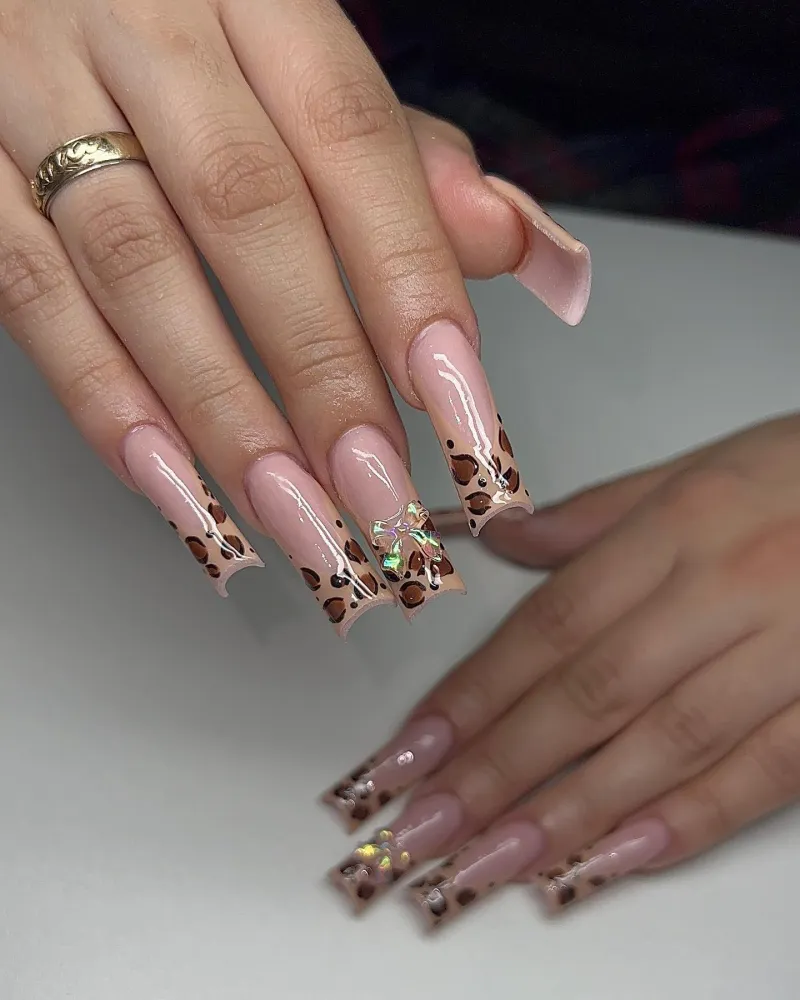
Commuter-Proof Nail Art: Four Looks Built for Grey Mornings and Busy Platforms
Photo: Dingee & Conard Co.; Henry G. Gilbert Nursery and Seed Trade Catalog Collection., Public domain, via Wikimedia Commons
November in the UK is not kind to a fresh manicure. It's dark by half four, the rain arrives sideways, and your hands spend the day gripping a damp umbrella handle, wrestling with a ticket machine and hauling a laptop bag up the stairs at the station. Whatever you had done on Saturday is going to be tested by Wednesday.
Which is why so many of us default to a plain polish and quietly give up on anything more interesting between October and February. That's a shame, because the most wearable nail art isn't the fussy kind — it's the kind designed to age well. Here are four looks that add personality without demanding a midweek repair job.
What 'low-maintenance' actually means
It doesn't mean boring, and it doesn't mean bare. A design is low-maintenance when it hides the three things that make a manicure look tired: growth at the cuticle, wear at the tip, and the odd chip or scuff.
Anything with a busy pattern, a hard colour boundary right at the base of the nail, or a lot of pale, opaque white is going to show its age quickly. Anything tonal, textured or deliberately irregular will keep looking fresh for longer. Keep that principle in mind and you can wear something far more interesting than you think.
1. Micro-French tips
The classic French has had a quiet makeover. Instead of the thick white smile line of the nineties, ask for a micro-French: a thin, 1–2mm tip in a soft off-white, blush or even a deep burgundy for autumn.
Why it works on a commute: the smile line sits right at the free edge, which is exactly where wear happens. A crisp line looks intentional; a slightly worn line looks like nothing at all. Choose a sheer pink or nude base rather than a solid one and growth at the cuticle becomes almost invisible.
How to ask for it: 'A micro-French on a sheer nude base, with the tip as fine as you can make it — maybe a millimetre.' Show a picture if you can. Bring your own reference for the base shade; 'sheer pink' covers a very wide range.
2. Tonal shimmer accents
This is the easiest win in the whole list, and the one most people haven't tried. Pick a base colour — think slate, mushroom, deep plum, forest green — then add a fine shimmer in a shade just one or two tones lighter or darker.
Applied as a gradient from the tip down, or as a shimmer overlay on two or three nails, it catches the light beautifully on a grey day and disguises scuffs remarkably well. A fine-particle shimmer is far more forgiving than chunky glitter, which tends to show every bit of lifting around the edges.
How to ask for it: 'A tonal shimmer over the top, something really fine — not glitter, more of a pearl.' If you're booking online, mention in the notes that you'd like a shimmer topper so they can set aside the time.
3. Negative-space detailing
Negative space means leaving part of the nail bare — usually a slim gap near the cuticle or a thin strip down one side — so the design floats rather than sits solidly on the nail.
It's the grown-out-friendly option. Because there's no hard line of colour at the base, a fortnight of growth doesn't create a visible gap. It also looks genuinely modern, especially in a single deep shade: a thin line down the side of two nails, a half-moon at the base, a small arc near the tip.
One caveat: keep the detailing away from the very edge of the nail, where it will be the first thing to chip. And if your nails are weak or peeling, negative space on natural nails needs a good smoothing base coat first — ask about that at the consultation.
How to ask for it: 'Negative space — a slim gap at the cuticle, no hard line, just one colour.' It's also worth mentioning that you want it to grow out gracefully.
4. A single chrome feature nail
Chrome is having a moment, but a full set of mirror-finish nails is a commitment. One accent nail — usually the ring finger — gives you all the shine with none of the upkeep anxiety.
Chrome powder sits over a gel colour and needs a proper top coat to protect it, because it scratches more easily than plain gel. On a single nail, though, the wear is manageable, and if it does dull slightly it's far less noticeable than it would be across ten fingers. Done over a dark base, it reads as sophisticated rather than novelty.
How to ask for it: 'A chrome finish on one ring finger over a dark gel, with a really solid top coat.' Ask what the removal involves, too — chrome sets usually need proper soaking off rather than a pick-and-peel.
How to ask for these at booking
A little advance notice makes a real difference, especially in a busy local salon. When you book, add a line to the notes: the style, the finish, roughly how many accent nails, and whether you want gel, BIAB or standard polish. If you're bringing inspiration, send it ahead — it helps your technician plan the appointment length.
And say if you're hard on your hands. Mention the commute, the dog, the gym, the fact that you open boxes with your thumb. A good technician will adjust the structure of the set accordingly, which does more for durability than any design choice.
Aftercare for actual real life
- Oil, daily. Cuticle oil is the single most effective thing you can do between appointments. Keep a bottle in your bag.
- Gloves for washing up. Not glamorous, but it's the difference between ten days and three weeks.
- Don't use your nails as tools. Keys, ring pulls, Sellotape — all culprits.
- Ask for a top coat refresh if you're near the salon around day ten. It's usually quick and cheap, and it resets the whole set.
- Never pick. If something lifts, book a repair rather than peeling it off; that's how natural nails get damaged.
Autumn nails don't have to be either plain or precious. Choose something tonal, keep the detailing away from the edges, and give your technician a heads-up when you book. Then get on with your morning — the 7:42 waits for nobody.